


Immediate Crisis Support
If you or someone you know is in distress or experiencing thoughts of suicide, please call or text 988 to reach the Suicide Crisis Helpline (24/7, free, and confidential), call emergency services at 911 or the Distress Centre Calgary at 403-266-4357, or visit your nearest emergency department.

Professional Trauma Counselling in NW Calgary
Viewpoint provides personalized, evidence-based counselling for trauma.
Our licensed therapists can help you process distressing experiences, soothe a hyperreactive nervous system, and regain a sense of safety, peace, and control through compassionate, tailored therapeutic approaches.
How Trauma Affects Us
We all experience painful events, upsetting news, or stressful disruptions. Usually, with time and support, our mind and body digest these experiences and return to a state of balance.
But when a traumatic experience remains unprocessed, it can feel like your internal danger response is perpetually stuck in overdrive or shut down completely.
You might find yourself perpetually on high alert, bracing for sudden danger even when you are technically safe. Rather than feeling present or grounded in your day-to-day life, you may feel detached, hypervigilant, or caught in distressing memories, intrusive thoughts, and emotional spikes. Meanwhile, on the inside, your body may hold deep physical tension or numbness, making it difficult to rest, trust others, or simply feel at ease in your own skin. Tasks and moments that should feel straightforward, like attending a social gathering, driving down a familiar street, or relaxing at home, can suddenly feel like overwhelming obstacles.
Common Symptoms of Trauma We Can Help With
Trauma expresses itself differently for everyone, often combining mental, emotional, and physical symptoms:
Hypervigilance & Irritability: Feeling constantly on edge, easily startled, or quick to react with frustration or fear.
Intrusive Memories & Flashbacks: Experiencing vivid, uninvited memories, nightmares, or physical sensations tied to past events.
Emotional Numbness & Avoidance: Steering clear of certain places, conversations, or feelings to avoid triggering uncomfortable distress.
Disconnection & Dissociation: Feeling detached from your body, surroundings, or loved ones, as if watching life from a distance.
Persistent Guilt, Shame, or Self-Blame: Carrying heavy internal narratives that you were somehow responsible for what happened.
Physical Stress & Muscle Tension: Holding chronic tension in the chest, shoulders, or stomach without a clear medical cause.


How Therapy Helps Heal Trauma
Healing from trauma does not mean forgetting what happened; it means helping your nervous system realize the threat has passed so past events no longer control your present life.
Our trauma-informed therapists work with you to:
Regulate the Nervous System: Learn grounding and somatic techniques to dial down “fight-flight-or-freeze” responses when you feel overwhelmed.
Safely Process Memories: Work through traumatic events at a manageable pace so they can be stored as neutral memories rather than active threats.
Rebuild Internal Safety & Boundaries: Establish clear personal boundaries and rebuild trust in yourself, your body, and your relationships.
Restore Agency & Self-Compassion: Shift away from self-blame and cultivate a supportive, empowered sense of identity.
Moving through trauma takes courage, but you don't have to carry the weight of it alone. Together, we can help you regain safety, heal deep wounds, and step forward into a calm, grounded future at a pace that feels right for you.
At Viewpoint, we recognize that trauma manifests itself differently for everyone, meaning there is no “one-size-fits-all” path to recovery.
Rather than forcing a rigid framework, our licensed therapists draw from a broad range of clinically proven modalities. Your treatment plan is uniquely tailored to you, blending your therapist’s specialized expertise with your specific goals, history, and comfort level.
Evidence-Based & Personalized Therapy at Viewpoint
Modalities & Clinical Frameworks We Utilize
Depending on your individual needs and the specialized approach of your therapist, your care plan may incorporate elements from:

Cognitive Processing Therapy (CPT)
Helps identify and reframe unhelpful beliefs or self-blame tied to traumatic events.

Somatic & Body-Oriented Modalities
Focuses on the mind-body connection to release physical tension and trauma responses held in the nervous system.

Internal Family Systems (IFS)
Works with different “parts” of your internal system to heal deep wounds, soothe protective behaviours, and restore inner harmony.

Eye Movement Desensitization and Reprocessing (EMDR)
Uses bilateral stimulation to help the brain reprocess traumatic memories and reduce their emotional charge.
THE VIEWPOINT APPROACH
Collaborative Care & Excellence
During your initial consultation, your therapist will discuss their clinical orientation and collaborate with you to design a therapeutic approach that feels safe, aligned, and effective for your journey. At Viewpoint, we are deeply committed to providing the highest quality of care; our licensed team regularly engages in structured, in-house peer consultation and continuous professional training. This collaborative framework ensures your care is enriched by the collective expertise of our entire senior team, keeping our methods sharp, modern, and clinically sound.
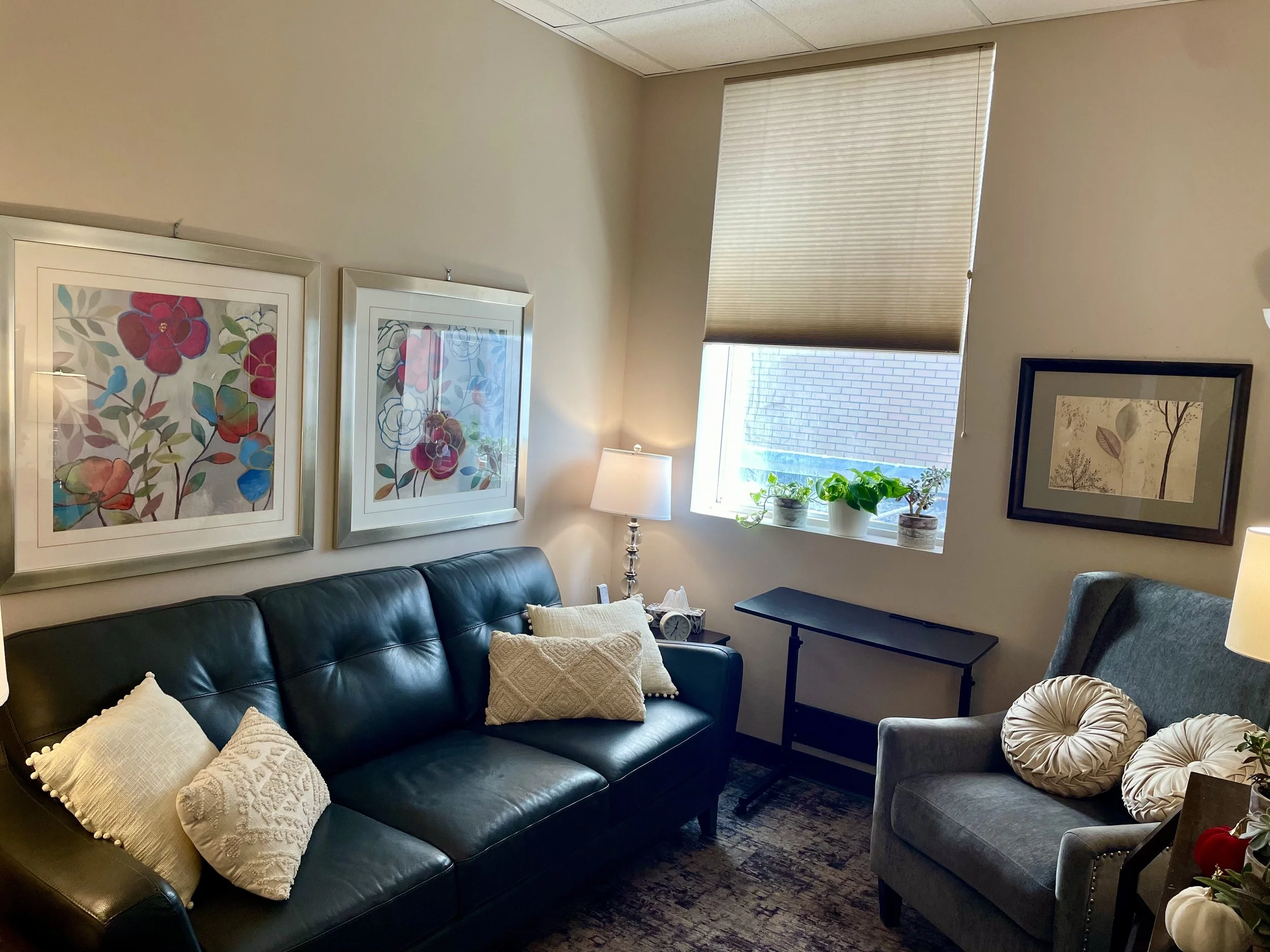
We also believe that accessing mental health support should not introduce extra friction or stress into your life. Whether you choose to meet with us in our calm, confidential space in NW Calgary or connect securely from the comfort of your own home via telehealth, our goal is to make your transition into therapy as smooth, direct, and supportive as possible.
Visit Our NW Calgary Clinic
Suite 221, North Hill Professional Centre, 1632 14th Avenue NW, Calgary, AB T2N 1M7

Located directly adjacent to the Lions Park LRT Station and major Calgary Transit bus routes.

Convenient on-site parking is available at North Hill Centre, featuring up to 3 hours of free surface parking, or 2 hours of free parking in designated zones which requires license plate registration, as posted.

Secure telehealth/online therapy sessions are also available if you are located anywhere in Alberta or Nunavut.


Frequently Asked Questions
-
If you find yourself repeatedly triggered by past events, experiencing sudden emotional spikes, feeling detached from your surroundings, or constantly on high alert, trauma-focused therapy can help. While general therapy focuses on day-to-day stress or life transitions, trauma counselling specifically targets how unintegrated experiences are stored in your nervous system and memory networks.
-
No. You are always in control of what you share and when you share it. Modern trauma therapies, such as EMDR and Somatic Experiencing, do not require you to recount every painful detail out loud. Our primary focus is first building safety, grounding, and stabilization so you can process memories at a pace that feels secure without becoming overwhelmed.
-
Yes, we offer in-person counselling at our clinic in the North Hill Professional Centre (Suite 221, 1632 14th Avenue NW, Calgary), as well as secure telehealth therapy for individuals located across Alberta.
-
Private counselling is not covered by Alberta Health Care. However, most extended health benefit plans (e.g., Sun Life, Canada Life, Manulife, Blue Cross) and Health Spending Accounts (HSAs) provide full or partial coverage for services provided by Registered Psychologists, Provisionally Registered Psychologists, or Licensed Social Workers. We recommend checking with your insurance provider prior to your first session to confirm your specific plan’s coverage details.
-
No, you do not need a doctor's referral to begin therapy at Viewpoint. We intentionally allow you to reach out and book an appointment directly with us to make accessing support as easy and seamless as possible, especially on days when your energy and motivation are low. While a small number of specific insurance policies require a physician’s note for insurance reimbursement, the vast majority allow you to self-refer and begin care immediately.
-
Trauma recovery is a personalized process with no fixed timeline. Some clients notice significant relief from single-event trauma in 8 to 12 sessions, while complex or childhood trauma often requires a longer, more gradual approach to build safety and processing capacity. Your therapist will regularly check in to evaluate progress and adjust your treatment plan to match your goals.
-
Traditional talk therapy engages the conscious, analytical mind to explore thoughts and feelings. EMDR (Eye Movement Desensitization and Reprocessing) uses bilateral stimulation, such as guided eye movements or alternating taps, to help the brain process traumatic memories naturally. This allows the nervous system to let go of the emotional distress tied to those memories without needing to talk through them endlessly.
-
Yes. Research comparing online and in-person cognitive behavioural therapy has repeatedly found comparable outcomes for treating clients, including a 2018 meta-analysis in Cognitive Behaviour Therapy that combined 20 studies of over 1,400 patients (Carlbring et al., 2018). Virtual sessions let you receive compassionate, high-quality care from the comfort and privacy of your own home, which can be especially helpful on days when low energy makes leaving the house difficult.
-
Yes. Trauma is not just a psychological experience; it is held in the body. When your nervous system remains in a constant state of fight, flight, or freeze, it can lead to chronic muscle tension, digestive issues, sleep disruptions, and exhaustion. Somatic approaches help release this trapped tension and restore your body’s natural baseline of calm.
-
It is completely normal to feel tired, sensitive, or emotional after processing difficult experiences. In trauma therapy, we emphasize grounding and emotional regulation skills early in the process so you have practical tools to use between sessions. We work at a measured pace to ensure you leave each session feeling steady and safe.
-
Your initial session will provide a comfortable, confidential space to share what you’ve been experiencing. You and your therapist will explore your current challenges, personal history, and goals for therapy to co-create a personalized care plan tailored to your pace.

Take the First Step Toward Healing
Restoring vitality begins with a single conversation. Contact our team at Viewpoint today to schedule an initial consultation with one of our licensed therapists and take your first step forward.