


Immediate Crisis Support
If you or someone you know is in distress or experiencing thoughts of suicide, please call or text 988 to reach the Suicide Crisis Helpline (24/7, free, and confidential), call emergency services at 911 or the Distress Centre Calgary at 403-266-4357, or visit your nearest emergency department.

Professional Depression Counselling in NW Calgary
Viewpoint provides personalized, evidence-based counselling for depression in NW Calgary.
Located in the North Hill Professional Centre, our licensed therapists can help you process persistent low mood, disrupt unhelpful thought cycles, and restore emotional vitality through compassionate, tailored therapeutic approaches.
What Depression Feels Like
At times, we all experience sadness, disappointment, or seasons where our motivation just slips away. Usually, these feelings pass as life and our situations change.
But when that low mood refuses to lift, it can feel like you are pushing through thick sludge every single day.
You might find yourself simply going through the motions each day. Rather than feeling any true contentment or joy in everyday life, you put on a brave face for your family, friends, or coworkers. Meanwhile, on the inside, you may feel completely drained, detached, or numb. Tasks that used to feel simple, like responding to a friend’s text, making your family’s dinner, or even getting out of bed each morning, now feel like monumental efforts.
Sadness vs. Clinical Depression Comparison Table
Note: The following information is for general knowledge, not medical advice. Consult a healthcare provider for diagnosis or treatment.
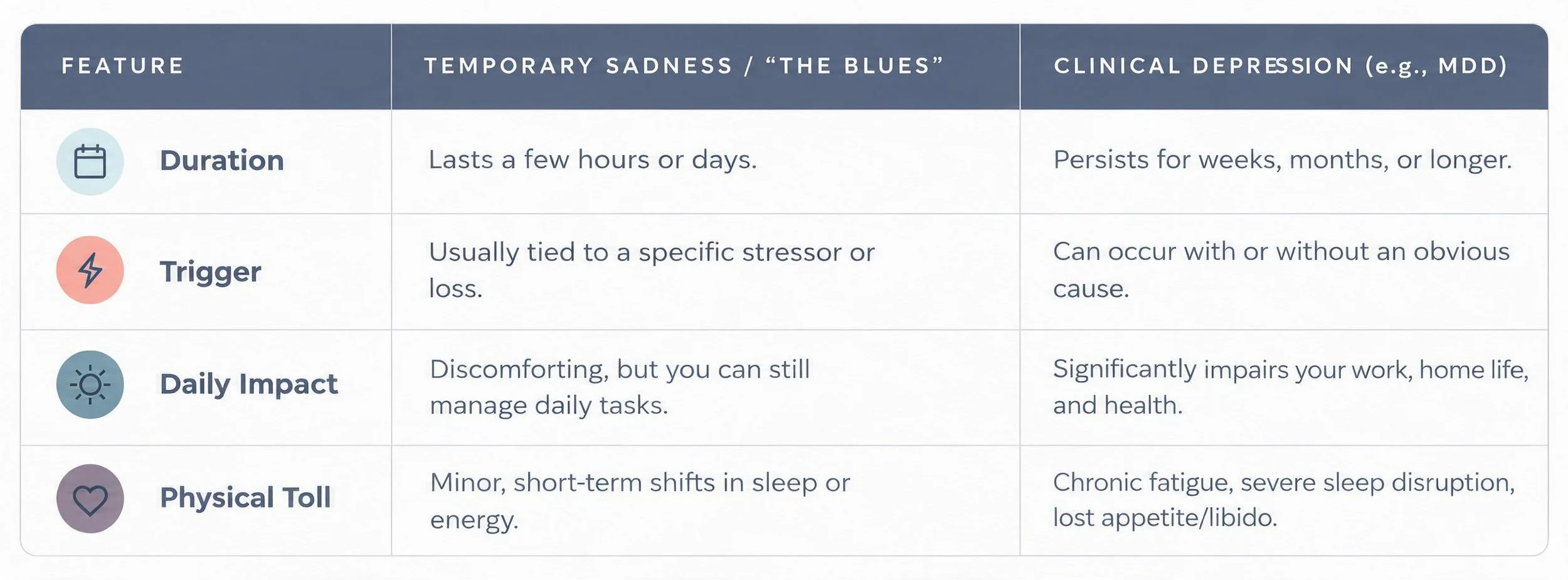

How Depression Can Unfold in Your Daily Life
Depression is rarely simply an emotional state. Rather, it is a full-body experience that affects how you move through the world. When left unaddressed, it can make every aspect of your life feel heavy and overwhelming:
Your Body: You may wake up exhausted no matter how long you sleep or experience poor quality of sleep. You may also notice that you carry unexplained physical tension or experience significant changes in your weight, appetite, and sex drive.

Your Mind: You might notice unhelpful thought loops that convince you that you are falling behind in life, failing in your career or at school, or that you have become a burden to your friends and family. Concentrating effectively can get harder — often experienced as a mental fog that makes work, school, or even simple decisions feel murky and slow. In its heavier moments, depression can also bring passing thoughts that life would be easier without you or a hopelessness that things will never get better. These thoughts are a recognized symptom of depression, NOT a character flaw, and they're something your therapist can help you work through.

Your World: You may withdraw from loved ones and other social connections because you are exhausted from trying to explain how you feel, leaving you feeling isolated, resentful of others, and disheartened about the future.

If you feel like you are running on empty or losing your way back to the person you used to be, it is not a personal failure, and you do not have to carry this alone.
At Viewpoint, we recognize that depression manifests differently for everyone — meaning there is no “one-size-fits-all” path to recovery.
Rather than forcing a rigid framework, our licensed therapists draw from a broad range of clinically proven modalities. Your treatment plan is uniquely tailored to you, blending your therapist’s specialized expertise with your specific goals, history, and comfort level.
Evidence-Based & Personalized Therapy at Viewpoint
Modalities & Clinical Frameworks We Utilize
Depending on your individual needs and the specialized approach of your therapist, your care plan may incorporate elements from:

Cognitive & Behavioural Therapies (e.g., CBT, ACT, DBT skills)
To help you disrupt unhelpful thought loops, challenge negative thinking, cultivate psychological flexibility, and realign your daily habits with your personal values.

Somatic & Body-Oriented Modalities
To address how depression holds tension in your physical body, helping you to regulate your nervous system and restore your physical energy.

Psychodynamic & Relational Therapies
To explore underlying relational patterns, past trauma, and long-standing emotional dynamics contributing to your low mood.

Mindfulness-Based Strategies
To build practical daily tools for emotional regulation and lower the risk of future depressive episodes.

Emotion-Focused & Humanistic Approaches
To safely process deep-seated emotional pain, strengthen your self-compassion, and foster authentic self-understanding.

THE VIEWPOINT APPROACH
Collaborative Care & Excellence
During your initial consultation, your therapist will discuss their clinical orientation and collaborate with you to design a therapeutic approach that feels safe, aligned, and effective for your journey. At Viewpoint, we are deeply committed to providing the highest quality of care; our licensed team regularly engages in structured, in-house peer consultation and continuous professional training. This collaborative framework ensures your care is enriched by the collective expertise of our entire senior team, keeping our methods sharp, modern, and clinically sound.
We also believe that accessing mental health support should not introduce extra friction or stress into your life. Whether you choose to meet with us in our calm, confidential space in NW Calgary or connect securely from the comfort of your own home via telehealth, our goal is to make your transition into therapy as smooth, direct, and supportive as possible.
Visit Our NW Calgary Clinic
Suite 221, North Hill Professional Centre, 1632 14th Avenue NW, Calgary, AB T2N 1M7

Located directly adjacent to the Lions Park LRT Station and major Calgary Transit bus routes.

Convenient on-site parking is available at North Hill Centre, featuring up to 3 hours of free surface parking, or 2 hours of free parking in designated zones which requires license plate registration, as posted.

Secure telehealth/online therapy sessions are also available if you are located anywhere in Alberta or Nunavut.


Frequently Asked Questions
-
If you have been experiencing persistent low mood, physical exhaustion, or a loss of interest in activities for more than two weeks, and it is interfering with your work, relationships, or daily self-care, professional therapy can provide essential support, clarity, and relief.
-
Yes. Depression isn't one single experience. It can show up as Major Depressive Disorder (MDD), Persistent Depressive Disorder (PDD, sometimes called dysthymia), Seasonal Affective Disorder (SAD), and other forms, each with its own pattern and duration. It's also common for depression to occur alongside anxiety, trauma, or other mental health concerns rather than on its own. During your first session, your therapist will help clarify what you're experiencing so your care plan addresses your unique needs.
-
Yes, we offer in-person counselling at our clinic in the North Hill Professional Centre (Suite 221, 1632 14th Avenue NW, Calgary), as well as secure telehealth therapy for individuals located across Alberta.
-
Private counselling is not covered by Alberta Health Care. However, most extended health benefit plans (e.g., Sun Life, Canada Life, Manulife, Blue Cross) and Health Spending Accounts (HSAs) provide full or partial coverage for services provided by Registered Psychologists, Provisionally Registered Psychologists, or Licensed Social Workers. We recommend checking with your insurance provider prior to your first session to confirm your specific plan’s coverage details.
-
No, you do not need a doctor's referral to begin therapy at Viewpoint. We intentionally allow you to reach out and book an appointment directly with us to make accessing support as easy and seamless as possible, especially on days when your energy and motivation are low. While a small number of specific insurance policies require a physician’s note for insurance reimbursement, the vast majority allow you to self-refer and begin care immediately.
-
Because recovery is unique to every individual, there is no fixed timeline. Some clients experience noticeable relief and clarity within four to eight sessions by learning immediate coping strategies. Others choose longer-term therapy to process deeper root causes and prevent future relapse. Your therapist will work collaboratively with you to review your progress and adjust session frequency as you heal.
-
A psychiatrist is a medical doctor who largely focuses on the biological aspects of depression, providing clinical diagnoses and managing antidepressant medications. A psychologist or therapist focuses on talk therapy—working with you to understand the root emotional patterns of depression, disrupt negative thought loops, and develop behavioural strategies. Because research shows that a combination of talk therapy and medication often yields the best long-term outcomes for depression, our therapists can work collaboratively alongside your psychiatrist or family doctor to support your complete care.
-
Yes. Research comparing online and in-person cognitive behavioural therapy has repeatedly found comparable outcomes for treating depression and anxiety — including a 2018 meta-analysis in Cognitive Behaviour Therapy that combined 20 studies of over 1,400 patients (Carlbring et al., 2018). Virtual sessions let you receive compassionate, high-quality care from the comfort and privacy of your own home, which can be especially helpful on days when low energy makes leaving the house difficult.
-
Yes. A 2024 systematic review and meta-analysis published in Frontiers in Psychiatry found that combined treatment (therapy plus medication) led to significantly better long-term outcomes than medication alone, including lower rates of relapse and rehospitalization (Voderholzer et al., 2024). Viewpoint therapists incorporate a holistic view into their work with you and can work collaboratively alongside your family physician or psychiatrist to support your complete care.
-
Yes. Movement is one of the better-supported complements to therapy. A 2024 systematic review and network meta-analysis in The BMJ found that exercise, particularly walking, jogging, yoga, and strength training, helped to reduce depressive symptoms about as much as standard treatments like therapy or medication (Noetel et al., 2024). Thus, while exercise is not a replacement for professional care, it can help you feel better and maintain the positive changes you make. Your therapist can help you build physical activity into your treatment plan so that it fits your energy levels and daily life — something that can feel a little overwhelming to start on your own when your motivation is already low.
-
Your initial session will provide a comfortable, confidential space to share what you’ve been experiencing. You and your therapist will explore your current challenges, personal history, and goals for therapy to co-create a personalized care plan tailored to your pace.

Take the First Step Toward Healing
Restoring vitality begins with a single conversation. Contact our team at Viewpoint today to schedule an initial consultation with one of our licensed therapists and take your first step forward.